Multimodal Learning Design: Why One Format Is Never Enough
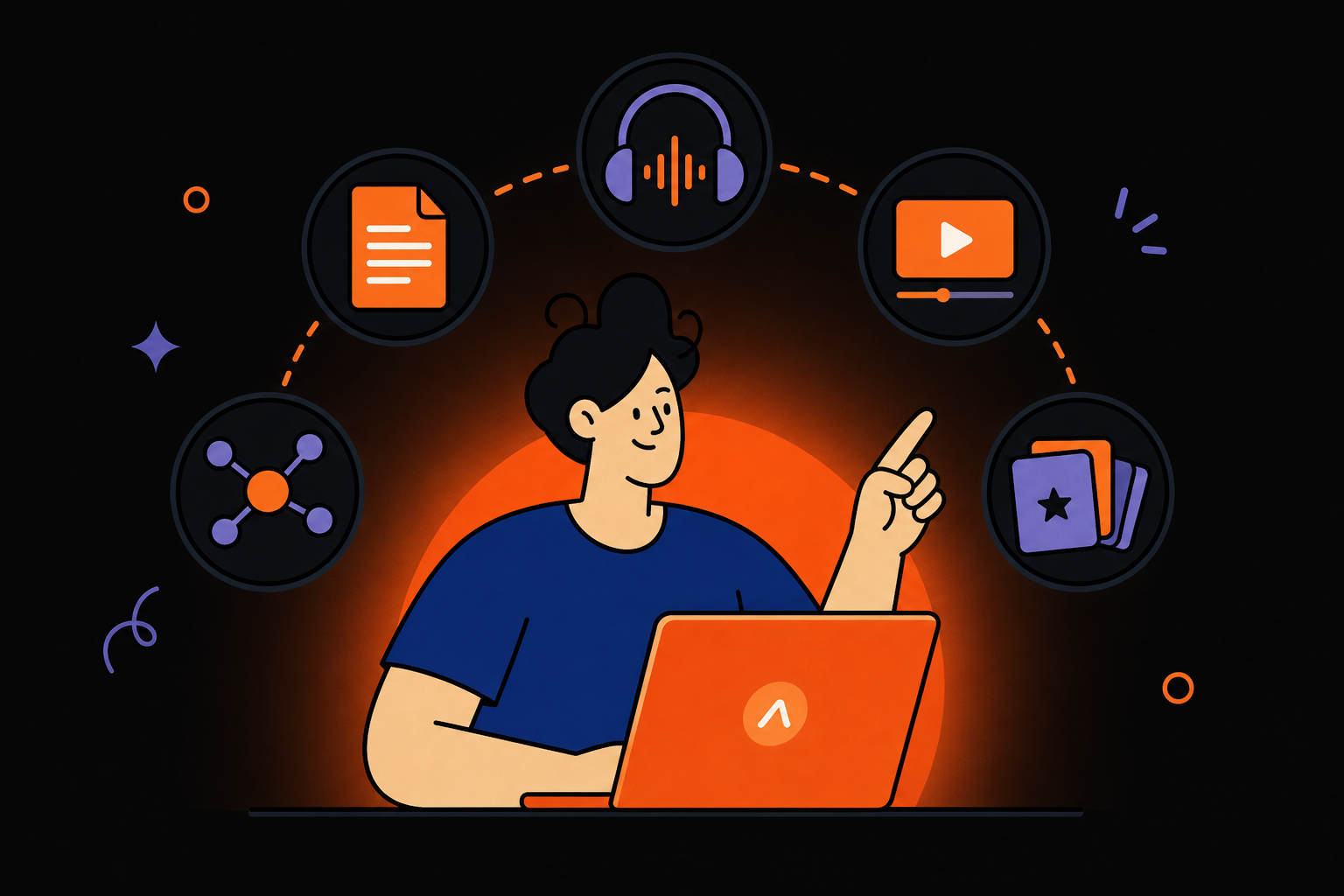
Dual-channel theory, the multimedia effect, and practical guidance for delivering the same course as text, audio, video, and flashcards, without quadrupling your workload.
Most corporate courses pick one format and stick with it: a PDF for compliance, a video series for onboarding, or a slide deck nobody reads. That choice feels efficient for the L&D team, one production pipeline, but it ignores how humans actually process information.
Richard Mayer's Cognitive Theory of Multimedia Learning (CTML), building on Paivio's dual coding theory, holds that learners have separate channels for visual/pictorial and auditory/verbal processing, each with limited capacity (Cambridge Handbook of Multimedia Learning). People learn more deeply from words and pictures together than from words alone, the multimedia principle that underpins modality-agnostic platforms like Sudar.
What “modality” means in practice
In learning science, modality refers to the sensory channel and presentation format: reading text, listening to narration, watching annotated video, interacting with flashcards, or exploring a visual map. These are not cosmetic skins on the same PDF, they activate different cognitive processes. Listening while commuting engages the verbal channel differently than scanning bullet points at a desk.
A 2024 field study on intelligent tutoring found that learner choice only helps when the underlying path is adaptive: choice on a linear course can actually hurt outcomes (arXiv:2402.01669). The design pattern that works: offer modality choice inside a coherent learning structure, not as a random buffet.
Four modalities that cover most corporate topics
- Read (text): Default for policy, procedures, and reference material. Best for skimming, searching, and learners who need to copy exact wording.
- Listen (TTS audio): Converts the same module to audiobook-style delivery. Critical for field workers, commuters, and auditory processors. Edge-TTS and similar tools make this near-zero marginal cost.
- Flashcards: Retrieval practice extracted from module content. Roediger and Karpicke's testing effect research shows active recall beats passive re-reading for long-term retention.
- Video / visual: Use when spatial or procedural demonstration matters (equipment handling, software clicks). Pair narration with aligned visuals per Mayer's contiguity principle, not voice-over unrelated stock footage.
“Multimedia instructional messages that are designed in light of how the human mind works are more likely to lead to meaningful learning than those that are not.”
Author once, deliver many: a practical workflow
- Structure content in blocks, not slides. Write modules as titled sections with clear learning objectives. Block-based authoring (headings, paragraphs, callouts, checks) maps cleanly to text, TTS, cards, and video scripts.
- Add one visual anchor per section. A diagram, screenshot, or relevant photo satisfies the pictorial channel without requiring a full video production team.
- Generate derivative formats from the source. AI can produce flashcards and audio scripts from the same module text. Sudar Studio authors once; Sudar Learn exposes modality tabs per module.
- Track which modalities correlate with completion. Log modality_switch events in your learning analytics. Some orgs see higher completion on Listen; others on Read. Let data inform defaults, not assumptions.
Design mistakes to avoid
- Redundancy overload: Reading identical text aloud while it appears on screen increases cognitive load (Mayer's redundancy principle). Listen mode should complement, not duplicate word-for-word on screen simultaneously.
- Modality without structure: Offering five formats on a disorganized wiki is not multimodal design; it is chaos.
- Video everything: Video is the slowest format to update when policies change. Keep video for high-value demonstration; use text for volatile content.
Further reading & research
- The Past, Present, and Future of the Cognitive Theory of Multimedia Learning
Richard E. Mayer · 2023 · Educational Psychology Review
Authoritative review of CTML evolution, dual channels, generative processing, and design principles.
- Improved Performances and Motivation in ITS: Combining ML and Learner Choice
2024 · arXiv:2402.01669
Learner choice + adaptive personalization improves outcomes; choice on linear paths can harm learning.
- Mental Representations: A Dual Coding Approach
Allan Paivio · 1986 · Oxford University Press
Foundational dual coding theory, verbal and nonverbal representations with referential links.