Why Your Learners Aren't Finishing Courses (And What the Evidence Says to Do About It)
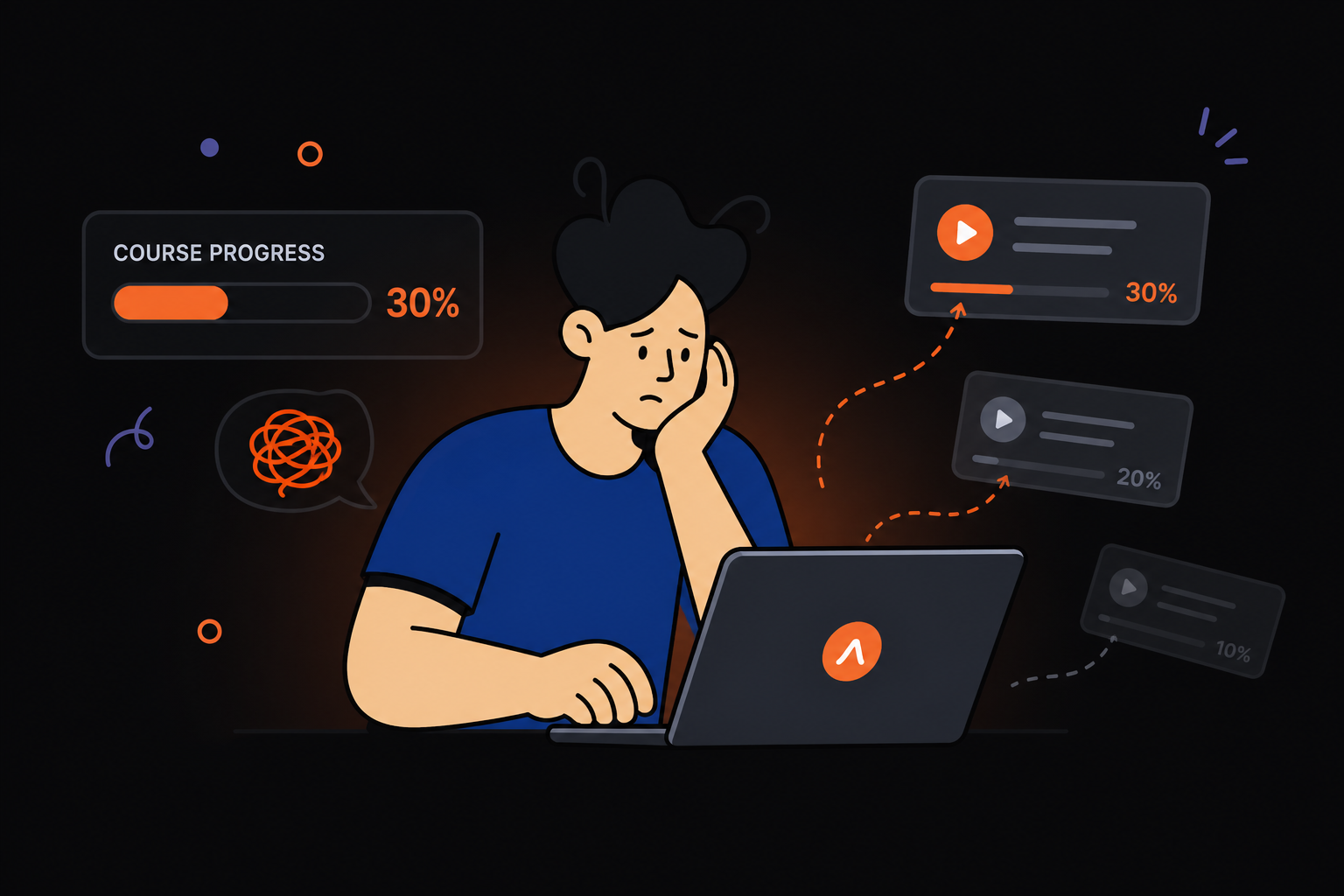
MOOC medians near 13% completion are not inevitable. Root causes, published research, and practical fixes, from modality mismatch to missing learner memory.
Low completion is the open secret of online learning. Aggregators tracking major MOOC platforms report a median completion rate around 12.6% (Class Central MOOC Report; see also Jordan, 2015). That means roughly seven or eight of every ten enrolled learners never finish, even when content is free and from top universities.
Before blaming “lazy learners,” look at the system. Completion is a design outcome, not a character trait. When researchers recalculate MOOC completion using learner intent (excluding casual browsers who never planned to finish), rates jump substantially, sometimes above 60% in specific cohorts (Open Praxis, 2024). Corporate mandatory training sits in between: higher than MOOC medians, but still dragged down by format mismatch, irrelevant content, and zero adaptation.
Five evidence-backed reasons learners quit
These patterns appear across MOOC research, corporate LMS analytics, and intelligent tutoring studies.
- Modality mismatch. Mayer’s Cognitive Theory of Multimedia Learning shows learners process verbal and visual information through separate channels with limited capacity. A text-heavy compliance course fails auditory learners; a 45-minute video fails readers who need to skim and search. Offering text, audio, flashcards, and video from one authored source aligns with dual-channel design (Mayer, CTML).
- No adaptation to prior knowledge. Advanced learners drop from boredom; novices drop from confusion. Intelligent tutoring meta-analyses find positive effects (g ≈ 0.27–0.42 in K-12 and broader samples) when systems model what the learner already knows (arXiv:2511.04997; Ma et al., 2014). Static paths treat everyone as identical.
- No memory across sessions. When a learner returns after a week and the platform treats them as new, motivation drops. Longitudinal tutor memory, referencing prior struggles and wins, is a core ITS design principle (VanLehn, 2011; D'Mello & Graesser, 2024).
- Weak early momentum. Survival analysis on large open courses finds that speed of completing early activities predicts final completion better than demographics alone (ECEL 2023). If module 1 is a 30-minute wall of text, module 2 never starts.
- No support at the moment of struggle. Learners quit when stuck, not when busy. Generative AI tutors grounded in course content can reduce study time while keeping personalization (arXiv:2403.14642). A FAQ PDF linked at the bottom of page 47 is not support.
“Our model attained superior completion rates and significantly improved student engagement when compared to alternative approaches.”
What actually moves completion rates
Adaptive sequencing is not hype. When implemented with learner models and rigorous evaluation, it changes outcomes. A 2022 randomized trial using contextual bandits (LinUCB) for exercise ordering reported higher completion, lower skip rates, and increased study time vs. a non-adaptive heuristic baseline (arXiv:2207.14003). A separate adaptive path navigation system (ALPN) reported ~8.2% better learning outcomes vs. knowledge-tracing baselines (arXiv:2305.04475).
Community and cohort structure also matter outside pure adaptivity, industry analyses cite 65%+ completion when discussion and cohort pacing are present vs. 10–20% for isolated self-paced content. The lesson: combine social structure where feasible with personalization at the individual level.
A diagnostic you can run this week
Pull analytics for your lowest-completion course and answer these questions:
- Where is the steepest drop-off? (Usually module 1 or the first quiz.)
- Average time on module 1: is it under 3 minutes (skim-and-quit) or over 20 (overload)?
- Do learners switch modalities, or is only one format available?
- How many tutor or help-desk questions repeat the same confusion point?
- Are completions concentrated among one department (suggesting relevance issue elsewhere)?
Fixes ranked by effort vs. impact
- Quick win: shorten module 1 and add a win. Cap intro modules at 5–8 minutes. End with a confidence-building check learners can pass. Early success predicts later completion in open-course survival models.
- Medium effort: enable multimodal delivery. Publish the same content as Read + Listen + Flashcards. Track which modality correlates with completion for your audience.
- Medium effort: deploy a course-grounded tutor. RAG-powered tutor over your modules answers “explain this” without leaving the flow. Course-specific chatbots in higher ed saw 10,000+ learner interactions in one deployment (MDPI, 2025).
- Higher effort: adaptive path ordering. Use learner event data (quiz scores, replays, pauses) to reorder or recommend next modules. Sudar’s next-best-action and adaptive path features implement this on the Digital Learner Twin.
- Strategic: measure intent, not just enrollments. Separate “assigned and started” from “browsed catalog.” Report completion against intentional learners, stakeholders make better decisions with cleaner denominators (Open Praxis MOOC study).
Completion is a lagging indicator of design quality
Chasing 100% completion on optional upskilling content is the wrong goal. Chasing high completion on mandatory training that people actually learn from is the right one. The research converges on a design stack: multimodal delivery, formative assessment, adaptive sequencing, and memory-aware support.
Platforms that only track clicks and certificates, without a longitudinal learner model, cannot implement that stack. That gap is exactly why adaptive learning research outpaced mainstream LMS product design for two decades.
Further reading & research
- Uncovering MOOC Completion: A Comparative Study of Completion Rates from Different Perspectives
2024 · Open Praxis
Completion varies sharply by denominator, enrolled vs. active vs. intentional learners.
- Raising Student Completion Rates with Adaptive Curriculum and Contextual Bandits
2022 · arXiv:2207.14003
RCT evidence for adaptive activity ordering improving completion and engagement.
- Adaptive Learning Path Navigation (ALPN) with Knowledge Tracing
2023 · arXiv:2305.04475
Adaptive paths outperformed KT-KDM baselines on learning outcomes and path diversity.
- Do Intelligent Tutoring Systems Benefit K-12 Students? A Meta-Analysis
2025 · arXiv:2511.04997
Significant positive effect (g = 0.271) across 18 U.S. K-12 ITS studies; moderators include worked examples and duration.
- Slow and Steady or Fast and Furious: Completion Duration Analysis
2023 · European Conference on e-Learning
Early activity completion speed predicts course completion better than demographics alone.
- Cognitive Theory of Multimedia Learning
Richard E. Mayer
Updated review of CTML principles, dual channels, limited capacity, active processing.